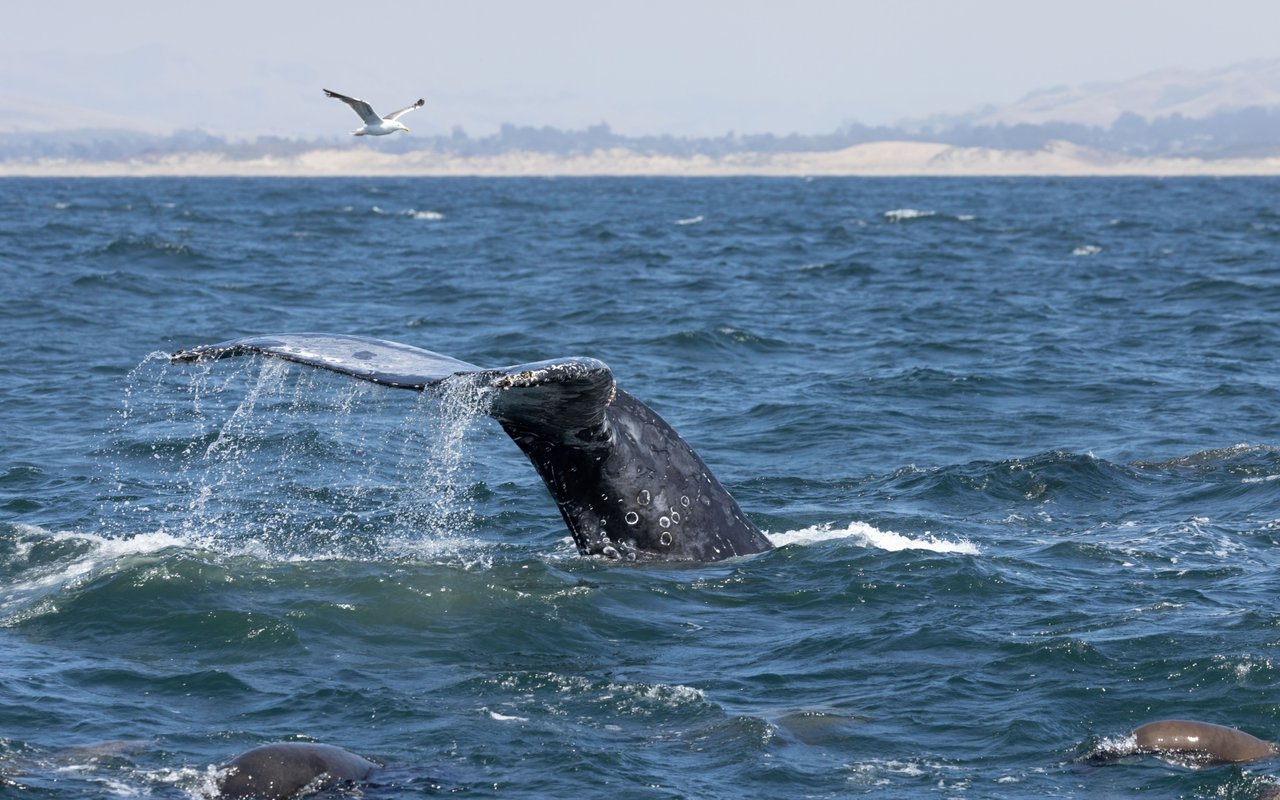
From December 1, 2024 through May 25, 2025, volunteers with the American Cetacean Society's Los Angeles Chapter counted gray whales from the back patio of the Point Vicente Interpretive Center. They recorded 130 southbound whales, and none of them were newborn calves. It was the first time in the project's history that no southbound calf was seen. The following winter, NOAA observers on the central California coast counted an estimated 2,563 whales between January 5 and February 13, 2026. From that count they estimated the eastern North Pacific gray whale population at 17,750 for the 2025/26 southbound migration, a figure NOAA's scientists called "an encouraging finding" in their July 2026 technical memorandum.
The two counts point in opposite directions. This December the Point Vicente patio opens for another season, and it is the closest place for a South Bay resident to see which one this coastline follows. You can watch from the bluff over the kelp beds or from a boat leaving the Redondo Beach waterfront, and either way you are seeing what the counters will record.
A Bluff Count and a Coastwide Estimate
The ACS-LA Gray Whale Census and Behavior Project has run for more than four decades from Rancho Palos Verdes. Its observation post sits on the Interpretive Center's back patio, 137 feet above kelp beds and a rocky shoreline. The sea floor there drops off sharply near shore. The census director, Alisa Schulman-Janiger, writes in the 2024–2025 season summary that the project is long-term monitoring of nearshore gray whales, and that most grays take offshore routes past the Peninsula. The patio count therefore tracks the whales that pass close enough to see from land, the same whales a resident with binoculars might pick out.
NOAA's estimate measures something different. Its observers count the southbound migration along the central California coast and use those counts to estimate the size of the whole population. Side by side, the two sets of figures show why one season's numbers carry weight for both groups.
Season | ACS-LA southbound count, Point Vicente | ACS-LA northbound count, Point Vicente | NOAA population estimate |
|---|---|---|---|
2023–24 | 225, including 22 calves | 579, including 34 calves | not listed in this post |
2024–25 | 130, no calves | 485, including 8 calves | 12,890, revised |
2025–26 | not listed in this post | not listed in this post | 17,750 |
For a longer baseline, the 2024–25 summary says earlier Point Vicente seasons had southbound totals between 293 and 1,902 and northbound totals between 521 and 3,412. At 130 southbound, the 2024–25 season came in well below the lowest of those earlier seasons. The team saw no gray whales at all on 50 of its 173 days. Many of those empty days had excellent sighting conditions.
Why NOAA Treats Its Own Good News Carefully
NOAA's July 2026 technical memorandum does not present the 17,750 figure as a clean recovery. The authors note that the recent jumps in the estimate, including the one from 2024/25 to 2025/26, are faster than gray whales are thought able to grow. They also came while calf production stayed low. The memorandum concludes that factors beyond births and deaths must be affecting how many whales pass the central California coast. It names sampling error, analytical bias, changes in detection, and possible changes in migratory behavior.
That caution follows a hard run of years. NOAA Fisheries declared an unusual mortality event for eastern North Pacific gray whales from 2019 through 2023. The agency associates it with changing food conditions in the Arctic and sub-Arctic feeding areas, along with malnutrition, fewer calves and higher mortality. In the Point Vicente summary, Schulman-Janiger described the 2024–25 season's low totals, low calf counts, many skinny whales and rise in strandings as "very concerning." She added the hope that the whales "will find good food sources and be in better body condition next season."
The bluff count matters here for a simple reason. If gray whales are changing their routes, a fixed, daylong count of nearshore whales off the Peninsula, taken by the same method season after season, is one of the records that would show it.
The Patio, From December 1
The census has run each season from December 1 through late May, staffed through daylight hours. In 2024–25, observer teams spent 2,013 hours on the patio over 173 days, an average of about 11.6 hours a day. One hundred volunteers contributed 8,767 effort hours. The chapter posts its daily counts on its website and its Facebook page during the season, so you can check the morning's tally before driving out. The running numbers appear on ACS-LA's daily count page.
The City of Rancho Palos Verdes calls the Point Vicente Interpretive Center a premier whale-watch site for the gray whale migration from December through April. The museum and gift shop are open 10 a.m. to 5 p.m. daily, and the park grounds are open dawn to dusk. The center sits beside the Point Vicente Lighthouse. Its exhibits on the Peninsula's natural and cultural history give special attention to the Pacific gray whale. Lower Point Vicente is part of the Palos Verdes Nature Preserve.
Timing a visit pays off. In 2024–25, the busiest southbound week at Point Vicente was January 25 through 31, and the highest single-day count came on January 27. The migration's official turnaround, when the flow shifted to mostly northbound, came on February 21. The northbound peak came on March 15. NOAA's highest daily count last winter, 158 whales, came on January 19, 2026. In both records, the southbound peak fell in the second half of January.
Gray whales are not the only animals the patio records. In 2024–25 the census team also logged blue, fin, humpback, minke and sperm whales. They saw common dolphins, coastal and offshore bottlenose dolphins, Pacific white-sided dolphins, Risso's dolphins, California sea lions, harbor seals and an elephant seal. Even on a slow gray whale day, the water below the bluff has other animals in it.
From the Water, Out of King Harbor
From the water, the season starts closer to home. Redondo Beach Whale Watch operates from 140 International Boardwalk in Redondo Beach and runs cruises year-round. Its rate page lists online starting prices of $41.40 for the standard Whale Watching Cruise and $77.63 for the High Speed Whale Watch. Tickets bought at the counter cost $10.35 more each, and the operator notes that starting rates can change. The operator describes the standard outing as a couple of hours. It names gray whales and dolphins as seasonal sightings, along with sea lions.
The December 2026 booking calendar lists a High Speed Whale Watch on Tuesday, December 1, the day the Point Vicente census has opened in past seasons. Standard Whale Watch departures begin December 4, and one December standard slot is listed from 1 to 3:30 p.m. On the opening day you can be on the water off Redondo while the volunteers count from the bluff to the south.
Larger whales come close to this stretch of coast too. On April 28, 2026, Easy Reader reported a fin whale about a mile offshore, off Redondo and Hermosa Beach. The paper called it a rare sighting for a species usually found well beyond the continental shelf, and noted that it drew several calls to local marine mammal responders. Easy Reader reminded readers to keep a respectful distance and to report a large whale close to shore to marine mammal authorities. A report should give the location, the time and what the whale was doing.
The Harbor Around the Landing This Winter
Anyone heading to the whale-watch landing this season will pass an active construction project. The U.S. Army Corps of Engineers began repairs on the King Harbor Breakwater on June 22, 2026. A barge moves along the breakwater as the work progresses, and crane operations run from Mole A. The City of Redondo Beach's update of November 18, 2026 asks visitors to stay off the breakwater during active construction and asks boaters to keep a safe distance from construction equipment and vessels.
The project's staging area is on Mole B. The city says the Army Corps will make every effort to keep Moonstone Park accessible and to let the Lanakila Outrigger Club keep operating. Parking on Mole B may still be reduced, because spaces next to Moonstone Park are being used for construction staging. No construction work is expected on November 26 or 27 for the holiday, or on December 12 for the boat parade. The repair is expected to finish in January 2027. The city also says that Yacht Club Way and other parts of International Boardwalk can close temporarily when conditions are dangerous. That notice is worth checking before a winter-storm departure.
The schedule lines up well. No breakwater work is planned over the Thanksgiving holiday, the boats start their December runs the following week, and the breakwater is expected to be finished around the time the southbound migration peaks. Our earlier notes on the Redondo Beach waterfront at Halloween cover the same streets around the landing, and more on the coast is on our Beach Cities neighborhood page.
At Auburn Properties, we pay close attention to the coastline we represent, from the bluffs of the Peninsula to the slips of King Harbor. If this winter has you thinking about what your own Beach Cities property and its view of the water are worth, we would be glad to prepare a confidential valuation, handled directly by a senior partner.