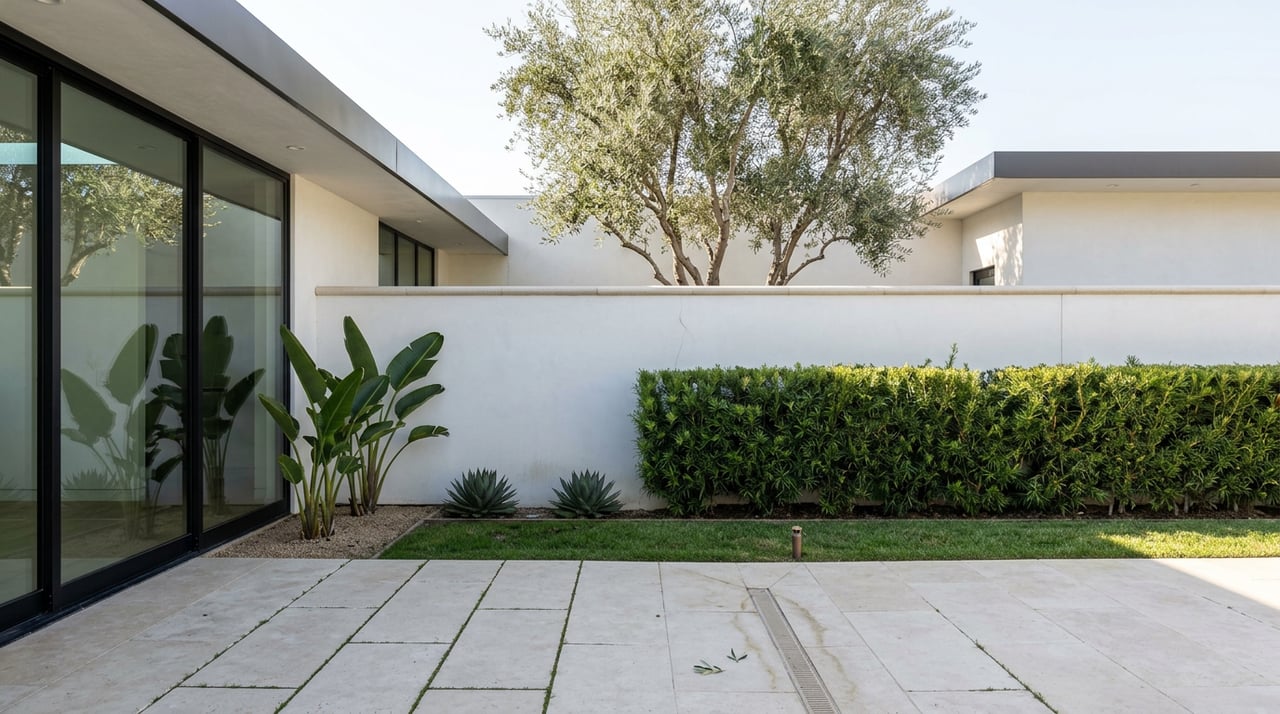
In early July 2026, Anthony Davis closed the sale of his Bel-Air estate at 2100 Stratford Circle for $32 million. The property had been listed almost a year earlier at $39.9 million, so the final number already reflected a discount of nearly 20 percent. Davis had purchased the home in 2021 for $31 million. On paper, that's a $1 million gain after four years of ownership in one of the tightest luxury markets in the country.
The closing statement told a different story. Because the sale price cleared Los Angeles's Measure ULA threshold, the transaction owed a 5.5 percent transfer tax on the full $32 million, close to $1.8 million, according to The Real Deal's reporting on the deal. That single line item was larger than the entire four-year appreciation on the property. Before commissions, before escrow fees, before anything else in a standard closing, the tax bill alone outran the gain.
Here's what makes that arithmetic worth sitting with. A few miles away, on the other side of a boundary that runs through hedges and country club fairways rather than anything a buyer would notice from the street, an identical sale would not have triggered that tax at all. Beverly Hills is not part of the City of Los Angeles. Bel-Air is. That single administrative fact, not square footage, not finishes, not view corridors, is now one of the largest variables in what a seller in either neighborhood actually keeps.
A Line on a Map, Not a Line on a Brochure
Beverly Hills has governed itself since incorporating as an independent city in 1914. Bel-Air, despite sharing a border, a school catchment feel, and a comparable architectural vocabulary of gated estates and hillside lots, sits entirely within Los Angeles city limits. Measure ULA, the transfer tax voters approved in November 2022 and that took effect in April 2023, applies only inside those city limits. It does not reach Beverly Hills, West Hollywood, Santa Monica, or several other independently incorporated cities in the county, each of which sets its own transfer tax policy separately.
The tax itself is straightforward to describe and easy to underestimate. It layers on top of the standard city and county documentary transfer taxes, and the thresholds move every year with inflation, tied to the Bureau of Labor Statistics Chained Consumer Price Index, according to the Los Angeles Office of Finance. For any closing after June 30, 2026, the current tiers are:
| Sale price | Additional ULA tax |
|---|---|
| Below $5.4 million | None |
| $5.4 million to $10.9 million | 4% of the full sale price |
| $10.9 million and above | 5.5% of the full sale price |
Before July 1, 2026, the tiers sat at $5.3 million and $10.6 million. The rates themselves haven't changed since the tax took effect. Only the entry points move, and only slightly, which matters more than it sounds like it should.
Why the Same Home Doesn't Split the Difference
The tax is calculated on the gross sale price, not on the gain. That distinction is the entire mechanism, and it's the part that catches sellers who assume a transfer tax works like a capital gains tax.
Picture a Bel-Air owner who bought at $5 million and sells at $5.5 million after several years. The gain is $500,000. But because $5.5 million clears the $5.4 million threshold, the 4 percent tax applies to the whole $5.5 million, not the gain. That's $220,000 owed at closing against a $500,000 profit. Nearly half the appreciation disappears into a single line item, and that's before the seller has paid an agent, an escrow company, or anyone else involved in the transaction.
This is why agents working the Westside describe the tax less as a closing cost and more as a variable that reshapes the entire pricing conversation before a home ever lists. Emil Hartoonian of The Agency told The Real Deal in July 2026 that the tax has become part of nearly every meaningful conversation about timing, pricing, and whether a sale makes financial sense at all. Some owners delay selling to avoid it. Others look at the carrying cost of a renovation and decide the tax, however large, is still the more predictable number.
The $400 Million Test Case
At the very top of Bel-Air's market, the same mechanism scales in ways that make the smaller examples look almost modest. A Bel-Air estate reportedly built for roughly $430 million on a $35 million lot has been positioned to test the national price record. If it sells at an asking figure near $400 million, reporting on the listing put the estimated ULA exposure alone at $23.8 million. That's a tax bill larger than most homes in Bel-Air sell for outright, attached to a single line on a single closing statement, purely because of which side of a city boundary the property happens to sit on.
No comparable estate in Beverly Hills carries that exposure at any price point, because the tax doesn't reach that jurisdiction at all.
What This Does to the Data You're Actually Looking At
Anyone comparing these two markets on paper runs into a strange pattern: the numbers don't hold still. Redfin's three-month window ending May 2026 put Bel-Air's median sale price at $3.35 million, with homes taking around 94 days to sell and closing about 6 percent under list. Over the same window, Beverly Hills posted a median sale price of $6.1 million, up 56.2 percent year over year. Meanwhile Bel-Air's median asking price in mid-2026 sat closer to $7.49 million, more than double its median sold price over roughly the same period.
That gap between what Bel-Air lists for and what it actually closes at is unusually wide, even for a luxury market where big swings are normal. Part of the explanation is simple math: at this price tier, monthly transaction counts run in the dozens, not hundreds, so a single $32 million sale or a single stalled listing can swing a median significantly. But part of it is the threshold itself. Sellers with homes priced near $5.4 million or $10.9 million have a real incentive to anchor their initial ask above the line and then negotiate down through it during escrow, rather than list at a number that signals the tax exposure up front. Beverly Hills sellers don't carry that same calculation into their pricing conversation, because there's no threshold to price around in the first place.
None of this means Bel-Air is a weaker market. Measure ULA has generated more than $1 billion in revenue since April 2023 across the city, and high-value Bel-Air sales continue to close, including the $32 million Davis transaction and others reported throughout 2026. It means the two markets, despite looking alike from a listing photo, run on different transactional physics, and a buyer or seller who treats them as interchangeable is missing a real cost variable, not a cosmetic one.
Where the Policy Stands Right Now
As of this writing, nothing is scheduled to change that math for a Bel-Air single-family sale. In July 2026, the Los Angeles City Council shelved a proposal that would have exempted new multifamily and mixed-use construction from ULA, opting instead to direct staff toward a pilot tax credit program for qualifying projects that has not yet been finalized. That effort was aimed at apartment and mixed-use development, not single-family estate sales, so it wouldn't have changed anything for a Bel-Air homeowner regardless of outcome. Separately, a statewide ballot measure that could have curtailed transfer taxes like ULA was withdrawn in favor of Proposition 43, which applies only to future tax measures and would not touch Measure ULA even if it passes in November 2026.
For a seller weighing a Bel-Air listing this year, the practical takeaway is that the threshold math needs to be part of the pricing conversation from day one, not something that surfaces on the closing statement.
Frequently Asked Questions
Does the ULA tax apply to every address in Bel-Air? Yes. Bel-Air sits entirely within Los Angeles city limits, so any qualifying sale above the current thresholds is subject to the tax regardless of which section of the neighborhood the property is in.
Who pays the tax at closing? Sellers typically bear the cost, since it's assessed on the transfer of the property and settled through escrow. It cannot be deferred through a 1031 exchange because it's a transfer tax, not a capital gains tax.
Could Beverly Hills ever become subject to ULA? Not under the current structure. Measure ULA is a City of Los Angeles ordinance, and Beverly Hills operates as an independently incorporated city with its own tax authority. Any change would require Beverly Hills to adopt a comparable measure on its own, which it has not done.
If you're weighing a purchase or a sale on either side of that boundary, the number that matters most isn't the list price. It's what actually lands in your account after the transfer tax, the escrow fees, and everything else that shows up on the settlement statement. Auburn Properties works with buyers and sellers across Bel-Air, Beverly Hills, and the surrounding Westside to model that math before a property ever hits the market. Request a confidential valuation to see what your specific address, and its specific side of the line, actually means for your net proceeds.